


Drive Shafts
A drive shaft transmits power and torque between drivetrain components, withstands stress while remaining lightweight, and uses joints to adapt to alignment and distance changes.
We are the original factory, specializing in various automotive air filters drive shafts and other automotive parts. Allproducts comewith a one year warranty service. The packaging can also be customized according to your needs. The quality is reliable and the priceis highly competitive. Welcome to inquire and purchase!
Advantages of Drive Shafts
Efficient power transfer
Drive shafts transmit engine power to the wheels efficiently, ensuring smooth acceleration and better driving experience.
Optimised weight distribution
Front-engine, rear-wheel-drive layouts use a drive shaft to send power to the rear wheels, optimizing weight distribution and improving handling, stability and traction.
Durability and strength
Drive shafts are usually made of steel or aluminum alloys, enabling them to withstand high torque and deliver durable, heavy‑duty performance.
Simplified maintenance
The simple design of drive shafts allows easy inspection, repair and replacement, simplifying maintenance and reducing downtime.
-
![Drive Shaft For Honda]() Drive Shaft For HondaRead More
Drive Shaft For HondaRead MoreThe drive shaft for Honda comes after the gearbox. It exists to transmit the torque (rotational force) provided by the engine to the wheels themselves in order to actually get the car moving. But why
-
![Drive Shaft For Ford]() Drive Shaft For FordRead More
Drive Shaft For FordRead MoreThe drive shaft for Ford helps transmit engine power to the front and rear tires. It’ s an elongated tube with drive shaft for Ford yokes (connectors) on its ends. A yoke links the drive shaft for
-
![Drive Shaft For Fiat]() Drive Shaft For FiatRead More
Drive Shaft For FiatRead MoreThe drive shaft for Fiat is a component of the drive train in a vehicle, with the purpose of delivering torque from the transmission to the differential, which then transmits this torque to the
-
![Drive Shaft For Dodge]() Drive Shaft For DodgeRead More
Drive Shaft For DodgeRead MoreThe drive shaft for Dodge helps transmit engine power to the front and rear tires. It’ s an elongated tube with drive shaft for Dodge yokes (connectors) on its ends. A yoke links the drive shaft for
-
![Drive Shaft For Chevrolet]() Drive Shaft For ChevroletRead More
Drive Shaft For ChevroletRead MoreA drive shaft for Chevrolet, also known as a propeller shaft and sometimes referred to as a transmission output shaft, is a vital component of your vehicle’ s drivetrain. It transfers power from the
-
![Drive Shaft For Cadillac]() Drive Shaft For CadillacRead More
Drive Shaft For CadillacRead MoreCompany Introduction Taizhou kingbo machinery co., Ltd. was founded in 2016. Before we established the company, we had over 10 years of practical experience in the market. We registered our brand,
-
![Drive Shaft For Buick]() Drive Shaft For BuickRead More
Drive Shaft For BuickRead MoreA drive shaft for Buick is a part of a drive train and goes by many other similar names, such as propeller shaft, drive line, and prop shaft. It is the component transmitting torque from the engine
-
![Drive Shaft For Benz]() Drive Shaft For BenzRead More
Drive Shaft For BenzRead MoreThe drive shaft for Benz also known as the propeller (prop) shaft or cardan shaft is the component in a vehicle that transfers the torque from the engine to other parts of the drive that cannot
-
![Drive Shaft For Audi]() Drive Shaft For AudiRead More
Drive Shaft For AudiRead MoreThe drive shaft for Audi is a component of the drive train in a vehicle, with the purpose of delivering torque from the transmission to the differential, which then transmits this torque to the
-
![Drive Shaft for Audi]() Drive Shaft for AudiRead More
Drive Shaft for AudiRead MoreOur drive shaft for Audi is designed and built with utmost precision and quality materials to meet the demanding requirements of modern vehicles. The drive shafts undergo rigorous testing to ensure
-
![Drive Shaft for Benz]() Drive Shaft for BenzRead More
Drive Shaft for BenzRead MoreOur Drive Shaft for Benz exemplify superior craftsmanship, precision engineering, and unmatched performance. With their exceptional durability and efficiency, they enhance the overall driving
-
![Driveg Shaft for Bmw]() Driveg Shaft for BmwRead More
Driveg Shaft for BmwRead MoreOur drive shaft for BMW is a very important component in a car, which transmits the power of the car to the drive wheels, enabling the car to drive normally. The drive shaft, also known as the half


Why Choose Us
Our product
Oem performance for overseas vehicle drive shafts, 60000km/1-2year product warranty, 100%performance test before delivery.
Quality control
TS16949 quality systerm, strong r&d ability, full range cover for all vehicle.
Our factory
Taizhou kingbo machinery co., ltd. Was founded in 2016. Before we established the company, we had over 10 years of practical experience in the market. We registered our brand, because our mission is to build a wolf warrior team and become the strongest distributor and oem manufacturer.
24h online service
We try and respond to all concerns within 24 hours and our teams are always at your disposal in case of any emergencies.
Do You Know the Basic Knowledge of Automobile Drive Shafts
Vehicles
An automobile may use a longitudinal shaft to deliver power from an engine/transmission to the other end of the vehicle before it goes to the wheels. A pair of short drive shafts is commonly used to send power from a central differential, transmission, or transaxle to the wheels.
Front-engine, rear-wheel drive
In front-engine, rear-wheel-drive cars, a long drive shaft transfers power to the rear axle. Common designs include the torque tube (one universal joint) and standard driveshafts (two or more joints). Most have the engine and gearbox at the front, with the driveshaft inactive when stationary. For better weight balance, some models use a rear transaxle, making the driveshaft spin constantly with the engine. Porsche’s system uses an engine-mounted clutch to disconnect the driveshaft, letting the engine rev freely during gear changes and reducing inertia. Its rigid torque tube also stabilizes alignment and resists torque twist. Half-shafts connect the rear differential to each wheel. Early cars often used chains, belts, or electric motors instead of drive shafts.
Four wheel and all-wheel drive
These evolved from front-engine rear-wheel drive. A transfer case between the transmission and axles splits drive to both axles, often with reduction gears, a dog clutch or differential. At least two drive shafts connect the transfer case to each axle; in some larger vehicles, a short drive shaft drives the centrally mounted transfer box. On such vehicles, the front drive shaft is shorter and more articulated, requiring more reliable or complex universal joints.
Modern light AWD cars often use a front-wheel drive–based layout: the transmission and front final drive are combined with the engine, and a single drive shaft runs to the rear axle. This design, with torque biased to the front, provides car-like handling.
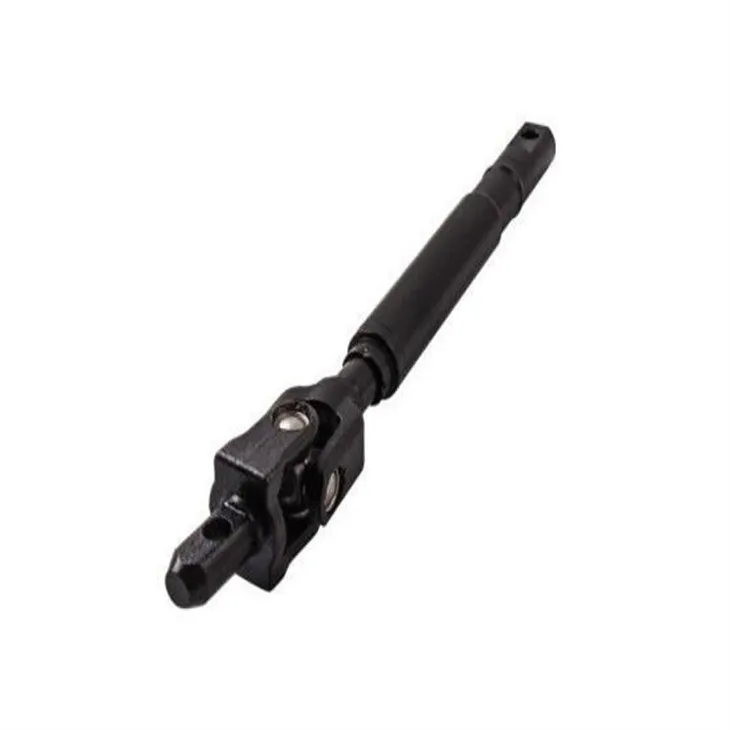
Vehicles have many moving parts, and the drive shaft (also called propeller shaft, prop shaft, or driveline) is critical to smooth operation. It is a spinning tube with yokes and universal joints that transmits power and torque from the engine/transmission to the differential and wheels, while absorbing movement to protect the drivetrain.
A broken drive shaft can cause major damage and leave the vehicle undrivable. Shaft designs vary by vehicle type (front-wheel, rear-wheel, four-wheel drive). If yours fails, it can be repaired or replaced. Understanding how it works helps you spot issues early and avoid further damage to surrounding components.
Anatomy of a Drive Shaft
Shaft body
The robust and cylindrical shaft body lies at the heart of the drive shaft. This component is purposefully designed to endure the engine’ s power and torque, ensuring smooth operation and power transmission.
Universal joints
Universal joints connect the various parts of the drive shaft. These joints provide flexibility and allow the drive shaft to accommodate the suspension movements of the vehicle. They enable the smooth transfer of power while maintaining optimal performance.
Flange yokes
Another crucial element in the drive shaft’ s structure is the flange yokes. These components play a vital role in establishing a secure connection, ensuring that the drive shaft remains tightly linked to other parts of the vehicle’ s powertrain system.
Slip yokes
Slip yokes are essential in maintaining a constant power flow throughout the drive shaft. They allow for slight movement and adjustability, compensating for the changes in length due to suspension travel or other factors.
Most vehicles are front-engine, front-wheel drive, offering stability but sometimes sluggish steering due to front weight. Drive shafts transmit engine power short distances to the front wheels.
They replaced simple belts or chains, as those couldn’t handle steering and road impacts. Drive shafts must accommodate independent axle and suspension movement.
Universal joints solve this: they let shafts rotate at the same speed while working at different angles, enabling safe, flexible power transfer.

Materials Used in Drive Shaft Construction
Steel
Steel drive shafts are known for their durability and strength. They can handle high torque loads and are often used in heavy-duty applications or performance-oriented vehicles. Steel provides excellent reliability and robustness.
Aluminium
Aluminium drive shafts are favoured for their lightweight nature. They offer weight savings compared to steel, which can contribute to improved fuel efficiency and reduced overall vehicle weight. Aluminium drive shafts are commonly found in a variety of vehicles, including sports cars and some trucks.
Carbon fibre
Carbon fibre drive shafts represent the pinnacle of lightweight construction. They offer exceptional strength-to-weight ratio and contribute to improved vehicle performance. Carbon fibre drive shafts are often seen in high-performance and luxury vehicles, where weight reduction is a priority. By utilising different materials, drive shaft manufacturers can tailor the component to specific vehicle requirements, striking a balance between strength, weight, and performance.
Common Applications of Automobile Drive Shafts
The automotive sector
Drive shafts are extensively used in four-wheel drive and rear-wheel drive vehicles to transfer power from the engine to the differential, propelling the vehicle’ s wheels.
The aerospace industry
Helicopters and aircraft rely on drive shafts within their transmission systems to transmit power from the engine to the rotors or propellers, facilitating flight.
The maritime industry
Ships and boats utilise drive shafts to transfer power from the engine to the propeller, enabling propulsion through water.
Industrial machinery sector
Drive shafts are an integral part of a wide range of industrial machinery, including agricultural equipment, conveyors, and manufacturing machinery, where they transmit power from engines to motors to various working parts.
Two-wheeled vehicles
Some motorcycles and bicycles incorporate drive shafts as an alternative to chain or belt drives, transferring power from the engine or motor to the rear wheel for propulsion.
Construction equipment
Drive shafts play a critical role in various construction machineries, such as cranes, loaders, and excavators. They transmit power from engines or motors to enable movement and operation.
Power generation industry
Drive shafts connect generators and turbines in power plants, facilitating the transmission of power from the generators to the turbines for electricity generation.
Our Factory
Taizhou kingbo machinery co., Ltd. was founded in 2016. Before we established the company, we had over 10 years of practical experience in the market. We registered our brand, because our mission is to build a Wolf Warrior team and become the strongest distributor and OEM manufacturer.


FAQ:
Q: What is the purpose of a drive shaft?
Q: How does a drive shaft work?
Q: How can drive shaft maintenance prolong its lifespan?
Q: Can a drive shaft be lengthened or shortened?
Q: What is the function of a constant velocity (CV) joint on a drive shaft?
Q: How does a drive shaft differ in a front-wheel-drive vehicle compared to a rear-wheel-drive vehicle?
Q: Are there performance-enhancing drive shaft options available?
Q: Can a drive shaft be upgraded for off-road use?
Q: How does a drive shaft contribute to fuel efficiency?
Q: What are the benefits of a balanced drive shaft?
Q: How can drive shaft alignment issues be diagnosed?
Q: Are there maintenance tips for extending the life of a drive shaft?
Q: What are the different types of drive shafts?
Q: What are the signs of a failing drive shaft?
Q: How often should drive shafts be inspected?
Q: Can a damaged drive shaft be repaired?
Q: What is a slip yoke on a drive shaft?
Q: How can drive shaft vibrations be corrected?
Q: Are drive shafts interchangeable between different vehicles?
Q: What is a center support bearing on a drive shaft?
As one of the leading drive shafts manufacturers and suppliers in China, we warmly welcome you to wholesale drive shafts for sale here and get free sample from our factory. All our products are with high quality and competitive price.
chassis systems, industrial drive shafts, axle drive shafts